Posted on
26 August 2025
Read time
5 minutes
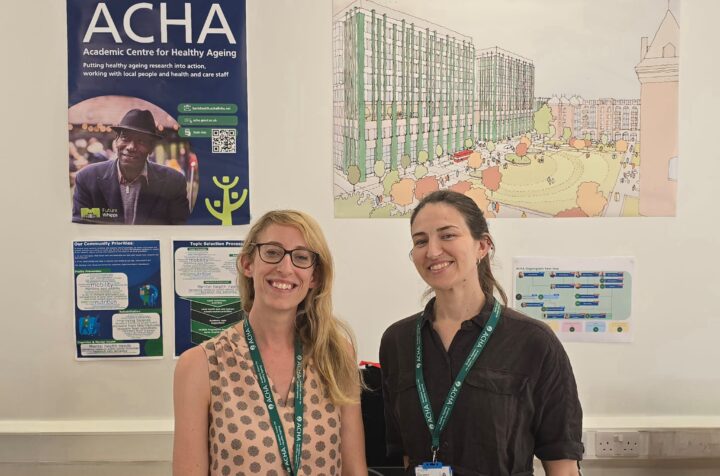
At the Academic Centre for Healthy Ageing (ACHA), research doesn’t happen in isolation—it’s grounded in the experiences of older adults, families, and frontline care staff. Two of our Senior Research Fellows, Drs Alexandra Feast and Krystal Warmoth are helping to shape this work, bringing both professional expertise and personal passion to the challenge of supporting healthier, more purposeful lives in older age. In this Q&A, they share how they found their way into research, what drives their focus on healthy ageing, and the exciting projects they’re working on today.
Q: Can you tell us a little bit about yourselves and how you got into research?
AF: I’m a Senior Research Fellow at ACHA, driven by a deep commitment to supporting older adults in living well as they age—ensuring their later years are not only healthy but full of purpose and meaning. Originally from France, I now call Hertfordshire home. Outside of work, life is a lively mix of parenting two young children—aged five and eighteen months—which means I often find myself more referee than participant! When time allows, I enjoy the restorative calm of nature, a good laugh from a favourite comedy, and the occasional well-crafted cocktail. My first NHS job for a couple of years was in a specialist secure unit caring for people with learning disabilities where I later volunteered on a research project helping to evaluate psychological interventions. The use of real-world data and the clear impact the intervention made to people I was caring for inspired me to get my first paid research role as a research assistant at Northeast London Foundation Trust.
KW: I’m a Senior Research Fellow at ACHA, focused on improving care for older adults, especially those living in care homes and managing frailty or multiple long-term conditions. I’m originally from rural Indiana in the USA. In my spare time, I enjoy pet sitting since I don’t have any pets of my own, and I love both cooking and eating vegan food. I first became interested in research while working as a Teaching Assistant for a psychology lab course during my undergraduate studies. The role involved running experiments with students and helping explain complex ideas, something I found both challenging and rewarding. It sparked a real enthusiasm for research and knowledge sharing, and I knew I wanted to pursue it further.
Q: What inspired you to focus on healthy ageing?
AF: My interest in healthy ageing was first sparked as a teenager, when I discovered the writings of Oliver Sacks. His vivid accounts of neurological disorders and their profound impact on individuals and their loved ones motivated me to better understand the brain and how to improve lives. This early fascination led me to pursue an MSc in Neuroscience, followed by a PhD focused on neuropsychiatric symptoms in people living with dementia.
As my career progressed, my focus evolved toward developing and delivering better care for people affected by dementia and other neurodegenerative conditions. I’ve become particularly interested in addressing complex challenges such as pain, delirium, and the management of multiple long-term conditions in later life. My work now centres on supporting an ageing population with increasingly complex needs, and on tackling the inequalities that often accompany ageing and ill health.
KW: After finishing my degree in 2010 I decided to take the leap and move to the UK to study. I didn’t even have a passport before then! I did a Master’s in Social and Organisational Psychology, then stayed on to do a PhD looking at how people’s views on ageing are linked to frailty in older adults. Since completing my PhD in 2015, I’ve been involved in a variety of projects in both the US and UK, looking at how to improve care in places like care homes and across health and social care services. My work has focused on supporting people’s wellbeing and quality of life, helping them recover after illness or injury, encouraging healthy habits and finding better ways to put good ideas into everyday practice.
Q: What are you working on currently?
AF: The NIHR James Lind Alliance (JLA) Priority Setting Partnerships (PSPs) are considered the gold standard for identifying research priorities in health and social care. The PSP consists of an expert group of patients, public and clinicians working collaboratively to set the research agenda for delirium prevention and management in the UK. This is the first of its kind nationally, and we are excited to share the top 10 research priorities shaping the future in delirium care.
We will shortly be evaluating the use of a new technology which visually assesses pain. Our aim is to ensure better identification and treatment of pain in people with dementia, or other memory problems in NHS hospitals. This will reduce suffering and improve quality of care, staff confidence and bring cost benefits. We will do this by implementing, testing, and evaluating this new tool which gives a voice to those unable to say they are in pain.
KW: I’m currently leading the development of a “Living Lab” in care homes, using a researcher in residence approach to work closely with staff, residents, and families. The aim is to identify and respond to real-world challenges in the sector through collaboration and co-produced solutions.
Q: What is the most exciting part about working in ACHA?
AF: This is the dream job as it connects research directly into frontline care. It is a privilege to work with the local community, academics, and clinicians to produce real-world evidence which can be rapidly translated into policy and clinical practice to expedite sustainable health and care transformation to benefit people as they grow older.
KW: My work in ACHA is important to me because of ACHA’s core approach and commitment to engage and involve the people who receive care and the staff who provide care. Care home staff and residents often have deep insight but are rarely heard in research and policy. By centring their voices, we can create more meaningful and sustainable improvements in care.